

Table of Contents
Key Takeaways
- RV combines travel and accommodation.
- India’s RV market is small but growing.
- Road trips and experiential travel are creating demand.
- High purchase and conversion costs are major challenges.
- Rental can be a bigger opportunity than ownership.
- Utilisation is the key to profitability.
- Maintenance and operating costs can be high.
- Demand is seasonal.
- Multiple revenue streams can improve profitability.
- India’s biggest opportunity is building a stronger RV ecosystem.
Imagine waking up in the mountains, making your own breakfast, stepping outside for a cup of tea and then driving to your next destination.
You do not have to check out of a hotel.
You do not have to wait for a taxi.
Your bedroom, kitchen, living room and vehicle are all moving with you.
This is the idea behind a Recreational Vehicle, or RV.
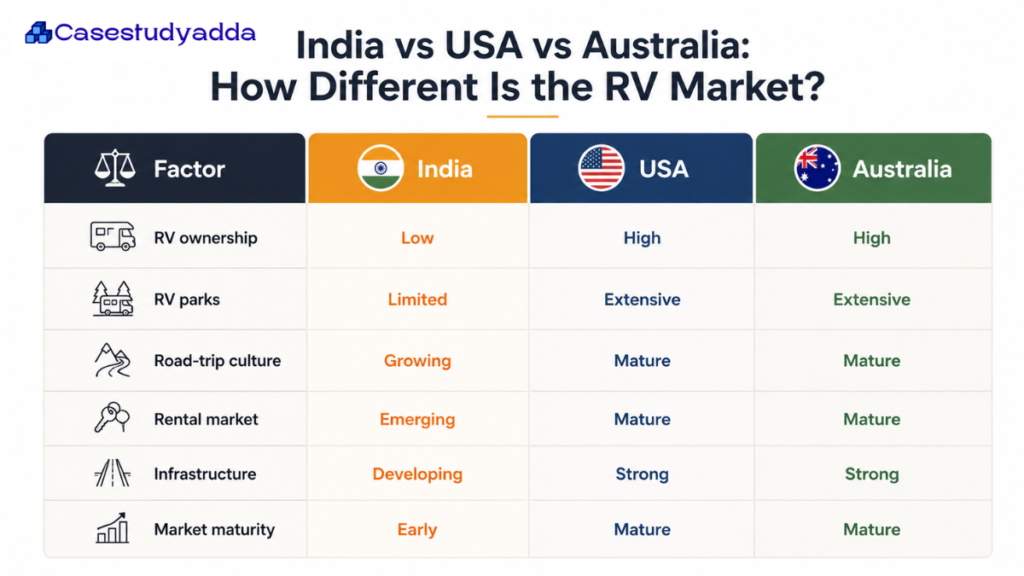
RV culture has been popular for decades in countries such as the United States, Australia and parts of Europe. In India, however, it is still a relatively small market.
But things are changing.
India has a huge domestic tourism market, better highways than before, growing interest in road trips and a younger generation that increasingly values experiences over traditional holidays.
The Indian government has also recognised caravan tourism as a tourism opportunity. Its caravan tourism policy specifically covers vehicles such as RVs, campervans and motorhomes and highlights the need for dedicated caravan parks.
So the big question is:
Is India ready for an RV revolution?
The answer is potentially yes, but not yet at the scale seen in the US or Australia.
The opportunity is real. The infrastructure and business ecosystem, however, are still developing.
Let’s understand the industry.
What Is an RV?
RV stands for Recreational Vehicle.
Simply put, an RV is a vehicle designed to combine transportation and accommodation.
Instead of travelling in a car and staying in a hotel, an RV allows you to travel and stay in the same vehicle.
Depending on the type, an RV can include:
- Sleeping beds
- Kitchen or kitchenette
- Refrigerator
- Dining area
- Toilet and shower
- Air conditioning
- Storage
- Entertainment systems
- Solar power
- Water tanks
- Charging systems
What are the types of RV tourism?
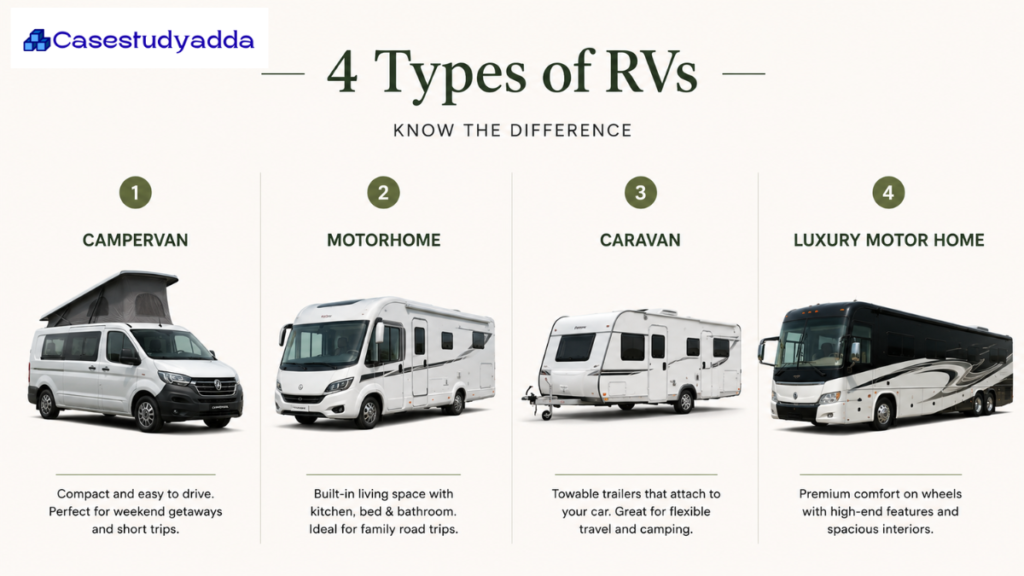
1. Campervan
A campervan is usually a smaller vehicle converted into a living space.
It is easier to drive and works well for couples and small families.
2. Motorhome
A motorhome is generally larger and offers more space.
It can have a proper bedroom, kitchen, toilet, shower and living area.
3. Caravan
A caravan is different because it is usually towed behind another vehicle.
The accommodation unit itself does not have its own engine.
4. Luxury Motorhome
This is the premium version.
Think of it as a small hotel room on wheels.
Some luxury motorhomes can have large beds, fully equipped kitchens, bathrooms, entertainment systems, Wi-Fi and other premium facilities.
The Indian Ministry of Tourism itself uses terms such as caravan, RV, campervan and motorhome when discussing caravan tourism.
Why Is RV Tourism Growing?
RV culture is not suddenly appearing in India.
Several changes are slowly creating the right environment for it.
1. Indians are travelling more
India’s domestic tourism market is enormous.
According to the Ministry of Tourism’s data dashboard, India recorded around 4.29 billion domestic tourist visits in 2025.
Even before this latest increase, official government data showed around 2.95 billion domestic tourist visits in 2024.
This does not mean billions of people are buying RVs.
It means something more important for the industry:
There is a massive pool of people already spending money on travel.
The opportunity is to convince some of these travellers to experience a different form of travel.
2. Road trips are becoming a holiday experience
For many Indians, the journey itself is becoming part of the holiday.
Instead of thinking:
Delhi → destination → hotel → sightseeing → return
travellers increasingly want:
Delhi → mountains → small towns → local food → scenic stops → destination
This is exactly where RVs can fit.
The RV is not just transportation.
The vehicle becomes part of the experience.
3. Experience-driven travel is becoming more attractive
A hotel room can be comfortable.
But an RV can offer something different.
You can:
- Sleep near a mountain
- Travel with your family
- Carry your own food
- Stop at scenic locations
- Spend more time in nature
- Change your itinerary
- Avoid changing hotels every day
This makes RV travel particularly interesting for people looking for experiential tourism.
4. Better road connectivity helps
India’s highway network has improved significantly over the past decade.
That does not mean every road is RV-friendly.
But better highways make long-distance road travel more practical.
This creates a basic foundation for road-trip businesses.
The next challenge is creating the infrastructure around those roads.
And that is where India’s biggest problem begins.
Who Is Buying or Renting RV business in India?
The Indian RV customer is very different from the traditional American RV customer.
India is still primarily a rental-led market.
Buying an RV is expensive.
Renting one allows people to try the lifestyle without making a huge investment.
Potential customer segments include:
1. Affluent families
Families travelling with children or senior citizens may value the convenience of having sleeping, eating and bathroom facilities inside the vehicle.
2. Couples
Young couples looking for weekend experiences can use smaller campervans.
3. Adventure travellers
People travelling to places such as Himachal Pradesh, Uttarakhand, Rajasthan, Kerala or the Northeast may find RV travel attractive.
4. Large groups
A large family or group of friends can potentially divide the cost of an RV across several people.
5. Corporate groups
Companies could use premium RVs for:
- Team trips
- Offsites
- Brand experiences
- Film production
- Events
6. Content creators
An RV can itself become content.
Travel creators can use campervans for long road-trip content, remote work and social media storytelling.
7. International tourists
Foreign tourists who are already familiar with motorhome travel may also represent a potential market.
Conclusion
India’s RV market is still small, but it has good potential. More people are enjoying road trips and looking for new travel experiences, which can create opportunities for RV businesses.
At the same time, high costs, limited RV infrastructure, maintenance and seasonal demand are still big challenges.
The key is not just to buy RVs, but to keep them running and earning throughout the year. With better infrastructure and more awareness, RV travel could become an exciting part of India’s tourism industry.
Frequently Asked Questions
Q1 – What does RV stand for in business?
RV stands for Recreational Vehicle. It is a vehicle designed for travel and living, usually with facilities like sleeping space, a kitchen, seating, and sometimes a bathroom.
Q2 – How is the RV business?
The RV business is a growing but still a slow market in India. It mainly earns through RV sales, rentals, customisation, and travel experiences. Rising road trips, domestic tourism, and interest in experiential travel are creating new opportunities.
Q3 – What does RV mean?
RV means Recreational Vehicle. In simple terms, it is a vehicle that lets you travel and stay in the same place, making it useful for road trips, camping, and long-distance travel.
Q4 – Is RV legal in India?
Yes, RVs are legal in India, but the vehicle must meet applicable registration, road-safety, vehicle modification, and motor-vehicle rules. The exact requirements can vary depending on how the RV is built and registered.
Q5 – What is the biggest RV company?
Globally, Thor Industries is one of the world’s largest RV manufacturers. It owns several major RV brands and has a strong presence in the global recreational vehicle market.
Q6 – How much does an RV cost to own in India?
In India, an RV can cost roughly ₹10 lakh to ₹1 crore+, depending on the base vehicle, size, interior, facilities, and level of customisation. A basic camper conversion can be much cheaper than a fully equipped luxury motorhome.