

Table of Contents
Imagine waking up in the morning, reading a major headline, and making money from it.
Not by buying stocks.
Not by investing in crypto.
Not by purchasing real estate.
But by simply predicting whether an event will happen or not.
Sounds unusual?
A few years ago, most people would have thought so.
Today, event trading is becoming one of the most talked-about segments in finance and technology.

What If You Could Trade the News Instead of Stocks?
People are trading contracts based on questions like:
- Will Bitcoin cross $200,000?
- Will inflation remain above 5%?
- Will a company launch its IPO this year?
- Will a political candidate win an election?
- Will interest rates be cut before the end of the year?
This growing market is known as event trading.
Some believe it is the future of forecasting.
Others believe it is simply a new form of betting.
Whatever side you choose but, one thing is clear:
Event trading is changing how people think about predicting the future.
Let’s dive in.
What Is Event Trading?
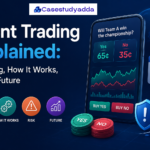
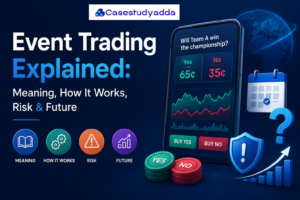
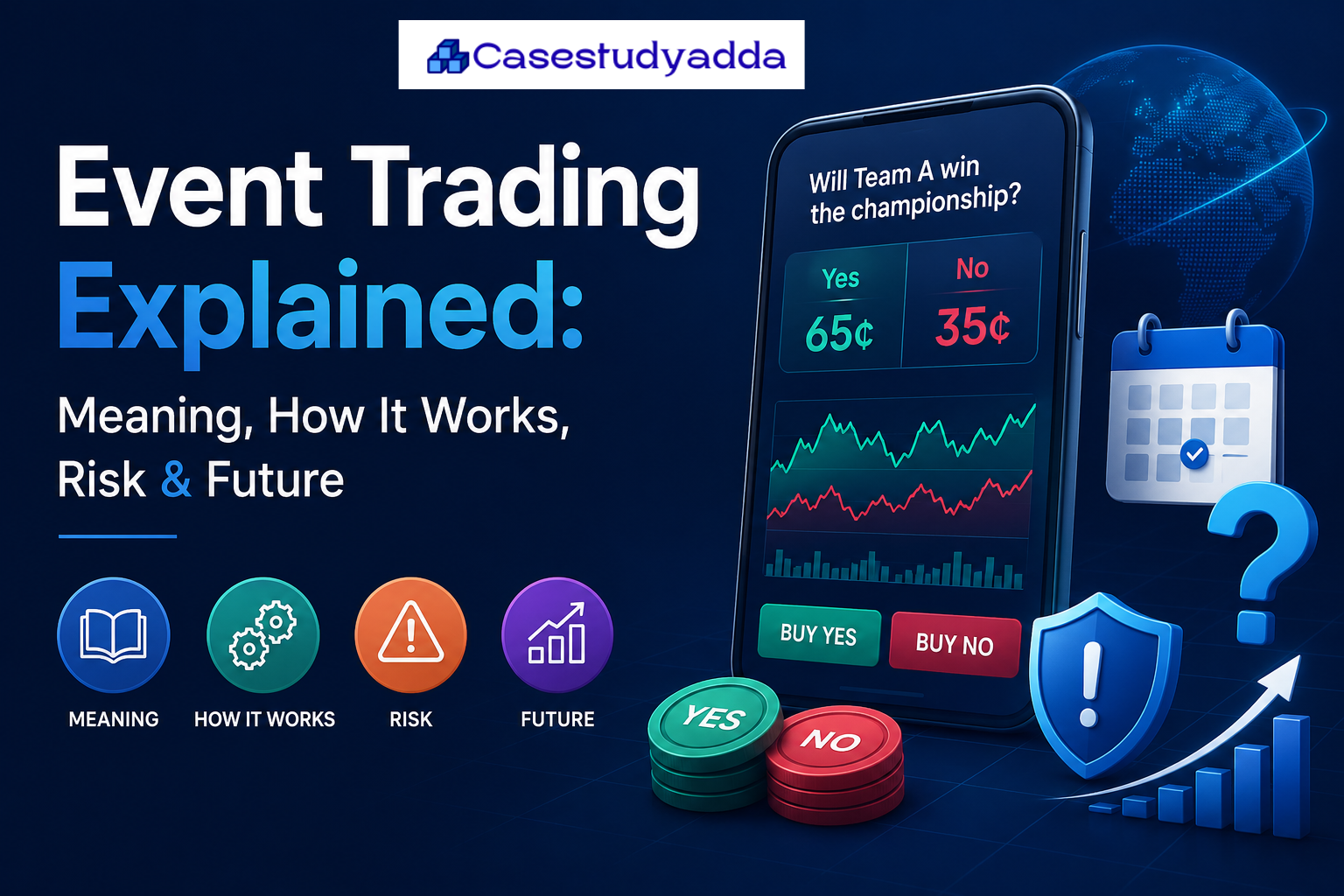
Event trading is the practice of buying and selling contracts based on the outcome of future events.
Instead of investing in a company or asset, traders invest in the likelihood of an event occurring.
Most event markets are based on simple questions:
- Yes
- No
For example:
Will Bitcoin reach $200,000 before December 31, 2026?
Traders buy either:
- Yes contracts
- No contracts
The market settles when the deadline is near which is based on the actual result.
If your prediction is correct, you earn a profit.
If you are wrong, you lose money.
Simple in theory.
Complex in practice.
Who Invented Event Trading?
The concept of trading markets is very old.
Historically, traders speculated on:
- Elections
- Wars
- Political outcomes
Modern prediction markets gained popularity through academic research.
One famous example was the Iowa Electronic Markets, launched by researchers studying election forecasting.
Over time, technological advancements transformed prediction markets into sophisticated trading ecosystems.
Why Is Event Trading Suddenly Becoming Popular?
Several trends have contributed to the rise of event trading.
1. More Accessible Technology
Online platforms have made participation easier than ever.
2. Real-Time Information
News spreads instantly through social media and digital platforms.
3. Growing Interest in Alternative Investments
Many traders are looking beyond stocks and cryptocurrencies.
4. AI and Data Analytics
Artificial intelligence has made forecasting more sophisticated.
5. Retail Participation
Individuals now have access to markets that were once limited to institutions.
As a result, prediction markets are attracting traders, economists, researchers, and businesses alike.
How Does Event Trading Actually Work?
The process is surprisingly straightforward.
Step 1: A Market Is Created
Example:
Will inflation exceed 5% this year?
Step 2: Contracts Are Priced
The market assigns prices based on collective expectations.
For example:
- Yes = ₹70
- No = ₹30
Step 3: Traders Buy and Sell
Participants take positions based on their beliefs.
Step 4: New Information Arrives
Any financial reports, major
Economic reports, news events, and announcements influence market sentiment.
Prices move accordingly.
Step 5: Market Settlement
Once the event outcome is confirmed, contracts settle.
Winning contracts pay out.
Losing contracts expire.
Understanding Event Trading Through a Real Example
Imagine the following market:
Will India’s GDP growth exceed 7% this year?
Current pricing:
- Yes = ₹65
- No = ₹35
The market is essentially saying:
There is a 65% probability that India’s GDP growth will exceed 7%.
If positive economic data emerges, the price may rise.
If growth slows, the price may fall.
The contract price continuously reflects changing expectations.
What Types of Events Can You Trade?
1.Political Events
Examples:
- Election winners
- Government formation
- Referendums
- Policy decisions
2. Economic Events
Examples:
- Inflation rates
- Interest rate decisions
- GDP growth
- Employment figures
3.Business Events
Examples:
- IPO launches
- Product releases
- Mergers and acquisitions
- CEO appointments
4.Sports Events
Examples:
- Tournament winners
- Championship outcomes
- Individual player performances
5.Cryptocurrency Events
Examples:
- Bitcoin price targets
- ETF approvals
- Regulatory actions
6. Entertainment Events
Examples:
- Award show winners
- Box office milestones
- Music chart rankings
How Do Event Trading Platforms Make Money?
Event trading platforms operate much like financial exchanges.
1. Trading Fees
A small fee is charged on transactions.
2. Market Creation Fees
Users may pay to create specialized markets.
3. Subscription Services
Advanced analytics and forecasting tools can be offered as premium products.
4. Institutional Data Services
Forecasting data may be sold to businesses and research organizations.
Why Do People Participate in Event Trading?
People join event markets for different reasons.
1. Profit Opportunities
Many traders seek financial returns.
2. Forecasting
Researchers use prediction markets to estimate future outcomes.
3. Hedging
Businesses and investors may use event contracts to manage risk.
4. Entertainment
Some participants simply enjoy testing their predictive abilities.
Is Event Trading Investing, Trading, or Gambling?
This remains one of the biggest debates surrounding prediction markets.
Why Do Some People Consider Investing?
- Requires research
- Uses market pricing
- Incorporates probability analysis
- Supports risk management
Why Do Some People Compare It to Gambling?
- Outcomes are uncertain
- Participants risk money
- Many contracts have binary outcomes
The reality is that event trading strategy shares characteristics with both investing and betting, which is why regulators often struggle to classify it.
How Are Event Trading Prices Calculated?
One of the most important concepts in event trading cards is probability pricing.
If a contract trades at:
- ₹20 → 20% probability
- ₹50 → 50% probability
- ₹80 → 80% probability
The market is essentially expressing the likelihood of an event occurring.
This makes event markets unique.
Prices become forecasts.
Why Are Prediction Markets Often More Accurate Than Experts?
Prediction markets are based on a powerful idea:
Collective intelligence.
Thousands of people contribute information.
Each trader brings:
- Knowledge
- Research
- Expertise
- Opinions
Together, these inputs create market prices that often outperform individual experts.
This phenomenon is commonly known as the Wisdom of Crowds.
Can You Actually Make Money Through Event Trading?
Yes.
But making money consistently is much harder than most beginners expect.
Successful traders focus on:
- Research
- Probability estimation
- Risk management
- Information analysis
They do not simply guess outcomes.
What are the biggest Risks of Event Trading?
1. Information Risk
Some traders may possess better information.
2. Liquidity Risk
Smaller markets may have fewer participants.
3. Regulatory Risk
Rules can change rapidly.
4. Emotional Bias
Personal beliefs can cloud judgment.
5. Market Manipulation
Low-volume markets may be vulnerable to large participants.
What are the Common Mistakes Beginners Make in Event Trading?
1. Treating Opinions as Facts
Believing something does not make it likely.
2. Ignoring Probability
Many beginners focus on outcomes instead of odds.
3. Following Social Media Hype
Popular opinions are not always correct.
4. Going All-In
Risk management remains essential.
5. Refusing to Change Views
Good traders update their beliefs when new information emerges.
What is the Psychology behind a Successful Event Trade?
The best event traders think differently.
They ask:
What are the odds?
Instead of:
Am I right?
Successful traders:
- Embrace uncertainty
- Think in probabilities
- Manage risk carefully
- Avoid emotional decisions
What is the Economics Behind Prediction Market?
At first glance, prediction markets look like betting systems.
Economists see something much more powerful.
Prediction markets function as information aggregation mechanisms.
Every participant enters the market with unique information.
The resulting market price reflects collective expectations.
1. The Wisdom of Crowds
Large groups can often forecast outcomes better than individual experts.
Prediction markets combine thousands of independent opinions into a single probability.
2. Incentive Alignment
Unlike surveys, participants have something at stake.
This encourages more thoughtful forecasting.
3. Efficient Market Theory
As new information becomes available, traders react.
Prices adjust.
Probabilities update.
The market continuously incorporates fresh information.
Why Are Economists Interested?
Prediction markets may help improve:
- Business planning
- Economic forecasting
- Public policy
- Scientific research
- Resource allocation
Many economists believe prediction markets could become one of the most effective forecasting tools ever created.
Can Companies Use Event Trading Internally?
Absolutely.
Some organizations use internal prediction markets to forecast business outcomes.
Instead of asking employees what they think will happen, companies allow them to trade on outcomes.
Examples:
- Will the product launch on time?
- Will sales targets be achieved?
- Will customer churn increase?
The resulting market prices often reveal valuable information that traditional reporting methods miss.
Benefits for Businesses
1. Better Forecasting
Employees across departments contribute insights.
2. Reduced Bias
Accuracy matters more than hierarchy.
3. Faster Decision-Making
Leaders gain real-time forecasts.
4. Improved Transparency
Concerns can surface before problems become serious.
Several large companies have experimented with internal prediction markets to improve planning and forecasting.
As AI-driven analytics become more common, internal prediction markets may become a standard management tool.
How AI Is Changing Event Trading?
Artificial intelligence is transforming prediction markets.
AI systems can analyze:
- News articles
- Social media trends
- Economic reports
- Historical data
This allows traders to estimate probabilities faster and more accurately.
Future prediction markets may increasingly combine:
- Human intelligence
- Machine intelligence
- Real-time data
Which Industries Could Be Impacted by Event Trading?
- Financial Services – Better forecasting tools.
- Research Firms – More accurate predictive models.
- Media Companies – Real-time public sentiment insights.
- Sports Analytics – Advanced probability tracking.
- Government Agencies – Improved policy forecasting.
Top 3 Major Event Trading Platforms Around the World
Several platforms have helped popularize event trading cards.
Examples include:
- Kalshi
- Polymarket
- PredictIt
These platforms allow users to trade contracts tied to real-world events, although availability depends on local regulations.
What Does the Future of Event Trading Look Like?
Event trading strategy is still in its early stages.
Future developments may include:
- Stronger regulations
- Greater institutional participation
- AI-powered forecasting
- Corporate prediction systems
- Global prediction exchanges
As forecasting becomes increasingly valuable, event trading cards could evolve into a major asset class.
Frequently Asked Questions
Is Event Trading Legal?
Legality depends on local regulations and the platform being used.
Is Event Trading the Same as Gambling?
Not exactly. While both involve uncertain outcomes, event trading strategy also functions as a forecasting and information-discovery mechanism.
Can Beginners Participate?
Yes. Many markets are easier to understand than traditional financial instruments.
Can You Lose Money?
Absolutely. Incorrect predictions can result in losses.
Why Are Prediction Markets Useful?
They aggregate information and often produce surprisingly accurate forecasts.
Final Thoughts: Are We Looking at the Future of Financial Markets?
For centuries, predicting the future has been valuable.
Event trading transforms that ability into a market.
By turning opinions into prices and probabilities into tradable assets, prediction markets create a unique intersection of finance, technology, economics, psychology, and data science.
Whether event trading strategy becomes a mainstream financial asset class or remains a specialized forecasting tool, its influence is already growing.
And as AI, data analytics, and global participation continue to expand, the question may no longer be whether event trading will grow.
The real question may be:
How much of the future will eventually become tradable?