The FIFA World Cup is the biggest football tournament in the world. It is organized by FIFA and takes place every four years.
This event is not just about football. It is a powerful global business model that generates billions of dollars. It also creates emotional connections with fans across countries.
In this FIFA World Cup case study, you will understand its business model, revenue sources, marketing strategy, economic impact, and the recent ticket price controversy in 2026.
History and Growth of FIFA World Cup
The first FIFA World Cup was held in 1930 in Uruguay with only 13 teams.
Today, the tournament has grown massively:
- 32 teams currently participate
- It will expand to 48 teams in 2026
- The 2026 World Cup will be hosted by United States, Canada, and Mexico
More than 5 billion people watch the World Cup globally. This makes it one of the most watched events in the world.
FIFA World Cup Business Model
The FIFA World Cup business model is centralized. This means FIFA controls all major rights and earns revenue from different sources.
1. Broadcasting Rights
Broadcasting rights are the biggest source of income.
Major broadcasters like:
pay billions of dollars to show matches.
This alone generates more than 3 billion dollars for FIFA.
2. Sponsorship and Partnerships
FIFA partners with global brands such as:
These companies pay for visibility, branding, and association with the World Cup.
3. Ticket Sales
Ticket sales are a major revenue source. Millions of fans attend matches in stadiums.
Ticket pricing depends on:
- Match importance
- Seating category
- Demand
This area has become controversial in recent years.
4. Merchandise and Licensing
FIFA earns money from:
- Jerseys and fan merchandise
- Licensing deals
- Video games like FIFA series
FIFA World Cup Marketing Strategy
The FIFA World Cup marketing strategy is one of the strongest in the world.
1. National Emotion
Fans support their country, not just a team. This creates strong emotional connection.
Example: When Argentina national football team won in 2022, there were celebrations across the country.
2. Star Players
Top players attract global attention:
- Lionel Messi
- Cristiano Ronaldo
- Kylian Mbappé
They increase engagement and viewership.
3. Storytelling
Every World Cup has stories:
- Underdog wins
- Big rivalries
- Emotional moments
This keeps audiences interested.
4. Digital Marketing
FIFA uses:
- Social media
- Video highlights
- Live updates
This helps reach younger audiences.
Economic Impact of FIFA World Cup
1. Benefits
- Increase in tourism
- Better infrastructure
- Global recognition
2. Challenges
- High cost of hosting
- Unused stadiums after the event
- Financial pressure on host countries
Example: Qatar spent over 200 billion dollars for the 2022 World Cup.
FIFA World Cup 2022 Overview
The 2022 World Cup was historic.
Key points:
- First World Cup in the Middle East
- Played in winter season
- Argentina won the final
Lionel Messi winning the trophy was a major highlight.
FIFA World Cup 2026 Ticket Price Controversy
The biggest recent issue in the FIFA World Cup case study is ticket pricing for 2026.
1. What Changed
For the 2026 tournament, FIFA introduced dynamic pricing.
This means ticket prices change based on demand.
2. Ticket Price Details
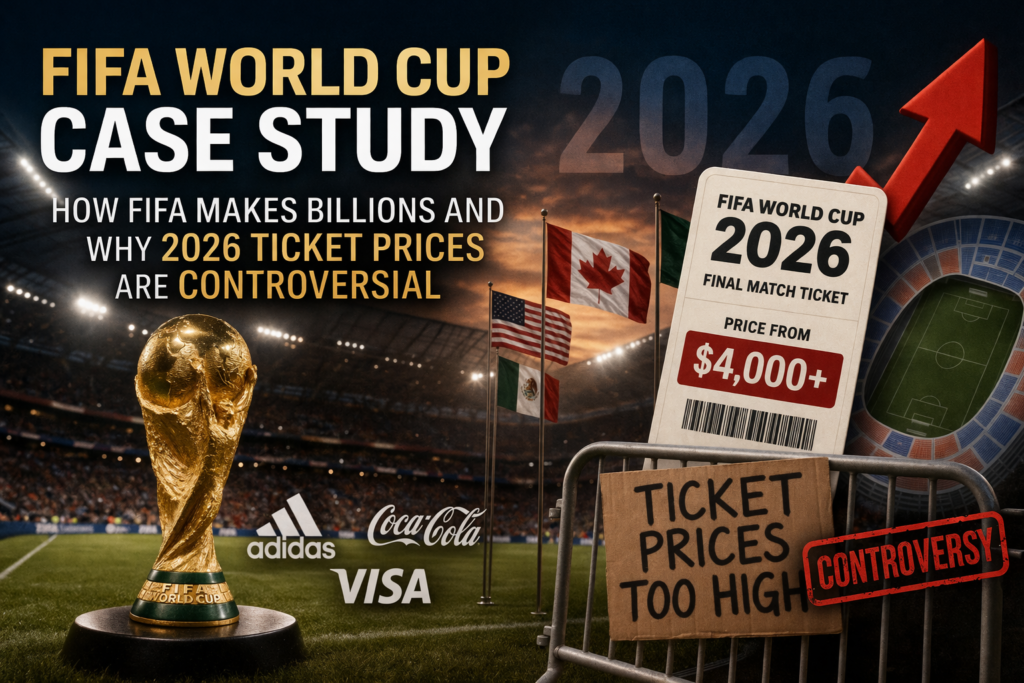
- Final match tickets start from around 4000 dollars
- Resale tickets have gone extremely high
- Normal match tickets are also expensive for average fans
Prices are much higher compared to the 2022 World Cup.
3. Why Fans Are Upset
Fans and organizations have raised concerns:
- Ticket prices are too high
- Pricing is not transparent
- Regular fans cannot afford to attend
Complaints have also been filed against FIFA in Europe.
4. FIFA Response
FIFA introduced:
- Limited lower priced tickets
- Special fan categories
However, these tickets are very limited and do not solve the main problem.
5. Key Insight
This controversy shows a shift in strategy.
The World Cup is moving from a mass event to a premium product.
This can be risky because football depends on common fans for long term growth.
Key Lessons from FIFA World Cup Case Study
1. Emotional Connection
The World Cup succeeds because it connects with emotions and national pride.
2. Strong Business Model
Multiple revenue streams make it highly profitable.
3. Global Marketing
FIFA has built a brand that reaches every part of the world.
4. Risk of Overpricing
The 2026 ticket price issue shows that too much focus on profit can damage fan trust.
Conclusion
The FIFA World Cup is one of the most successful global events.
It combines sports, business, and marketing at a massive scale.
However, the 2026 ticket pricing controversy highlights an important challenge.
FIFA must balance revenue and accessibility. If fans feel excluded, the long term value of the tournament can be affected.